Door op "Alle cookies aanvaarden" te klikken ga je akkoord met het opslaan van onze cookies op je computer. Zo kunnen we een betere gebruikservaring bieden, en het laat ons toe om het gebruik van de website te analyseren. Door op ‘Je voorkeuren aanpassen’ te klikken kan je kiezen welke cookies je toelaat. Enkel de essentiële cookies zijn noodzakelijk voor de goede werking van de website en kan je niet weigeren
Onze website bewaart vier soorten cookies. Je kan zelf op elk moment kiezen welke je aanvaardt en welke niet. Meer informatie over wat cookies zijn en welke types cookies we verzamelen kan je lezen in ons cookiebeleid.
New sounds. New experiences. New listening. From analog pulses to digital noise: experience music beyond the expected.
Tectonics is a boundary-pushing festival for new and experimental music, launched in 2012 by conductor Ilan Volkov, a true musical omnivore with an insatiable curiosity and wide-ranging taste. Since then, it has grown into one of the world’s most eclectic and highly regarded festivals for those drawn to new sounds, bold experiments, and music that ventures beyond the expected.
In June 2026, the Brussels Philharmonic and Ictus bring Tectonics to Brussels for the first time, taking over Flagey for two packed and compelling days.
Why "Tectonics"? For over a decade, artists from around the world have gathered in Glasgow with a shared goal – to push the boundaries of their art form, often challenging its basic ground rules. An earthquake, while destructive, also brings renewal and change. Despite being a beautiful, old-fashioned musical structure, I know that an orchestra still has much to offer - and exploring this has been at the core of my journey with Brussels Philharmonic. The logical next step was to bring Tectonics to Brussels: together with Brussels Philharmonic, Ictus and Flagey we will present a festival focused on the profound act of listening and the potential of collaboration. Embrace the music with openness. Trust the composers, performers… and yourself! It often leads to exciting and transformative experiences.
music by Frederic Rzewski, Coming Together / Attica by Ictus: Dirk Descheemaeker (bass clarinet), Aurélie Entringer (viola), Gerrit Nulens (percussion), Tom Pauwels (e-guitar),Jean-Luc Plouvier (synthesizer), Eva Reiter(Paetzold flute),Alexandre Fostier (sound) and Tarek Halaby (narrator)
-----
Frederic Rzewski (1938–2021) created, with this 1975 diptych, one of the most powerful works for narrator in modern music. The piece is rooted in the Attica prison uprising (New York, 1971), where inmates demanded to be treated as human beings. The repression cost more than forty lives. Rzewski based the work on a letter by Sam Melville, one of the victims. In a sharp mix of exhaustion, resilience, and irony, he describes how self-discipline helps him reclaim his dignity. Over a modal bass line, Rzewski builds a strict structure based on the numbers 7 and 49. He ‘locks’ the text in place, while the music’s irrepressible energy pushes against those limits.
Brussels Philharmonic & Ilan Volkov: Can you listen to a building?
music by Øyvind Torvund, Symphony for Kunstnernes Hus by Brussels Philharmonic, Ilan Volkov (conductor), Signe Emmeluth (saxophone), Jørgen Træen (synths), Jennifer Torrence (percussion)
-----
Øyvind Torvund’s Symphony for Kunstnernes Hus is a symphony that presents itself as an artwork—and an artwork that takes the shape of a symphonic concert. An immersive experience unfolds throughout the building, with simultaneous musical moments inviting the audience to move freely and fully immerse themselves in the sound.
The duo of Farida Amadou and Heather Leigh brings together two singular voices in contemporary experimental music. Working in the realm of free improvisation, they weave dense, visceral soundscapes where Amadou’s heavily processed electric bass collides with Leigh’s expansive, emotionally charged pedal steel guitar. Their music unfolds as a raw dialogue of texture, tension, and fleeting lyricism, constantly shifting between abstraction and deep sonic immersion. Their collaboration carries the spirit of their dearly belated friend and mentor, Peter Brötzmann, whose uncompromising approach to sound and improvisation continues to resonate through their work. Amadou and Leigh first performed as a duo at Cafe OTO in 2024, as part of the Brotz Festival honouring Brötzmann’s legacy. They later brought their collaboration to Summer Bummer Festival, further developing their intense and exploratory sonic language in a live setting.
Ictus: Interference & Leonie Strecker / Pak Yan Lau
music by Leonie Strecker, Interference / chroma accuracy and Pak Yan Lau & Anita Cappuccinelli, Duet by Leonie Strecker (electronics), Pak Yan Lau (prepared piano) and Ictus: Anita Cappuccinelli (percussion), Dirk Descheemaeker (bass clarinet), Alexandre Fostier (sound)
-----
Improvised music is, by definition, spontaneous – but it also draws on experience, reflection, experimentation, and personal taste. Over the years, PakYan Lau has developed a distinct sonic language using prepared pianos, toy pianos, synths, electronics, and a wide range of sound objects. For this set, she invites percussionist Anita Cappuccinelli (Ictus, TUUM). Together, they explore the unpredictable: what keeps shifting, what resists being fixed – music without a past, created in the moment.
Two works by Leonie Strecker complete the programme: Interference and chroma accuracy. She explores presence and absence, and the tension between memory and experience. Both pieces play with interference tones and shifting sonic layers: chroma accuracy leans into rhythm, while Interference focuses on the space between sounds.
-----
LINEUP Day #2
Saturday 20.06 · Studio 3, 17:15 & 22:00 (free)
Ictus: Micro Breaths of a Blue Lung
music by Fabio Machiavelli by Fabio Machiavelli (live electronics), Maris Pajuste (voice), Eva Reiter (sound devices), Tom De Cock (sound devices), Alexandre Fostier (sound)
-----
“First we shape our tools and then they shape us.” – John M. Culkin
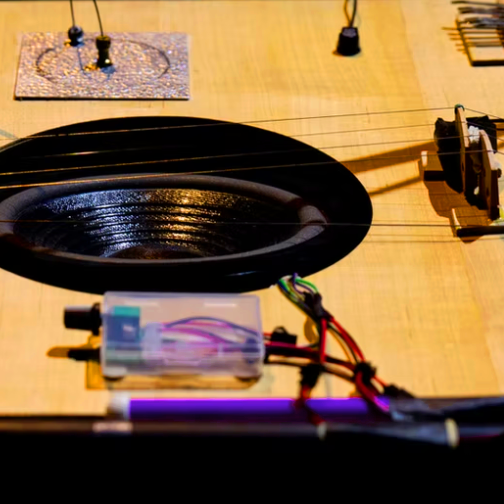
At the heart of Fabio Machiavelli’s work lies the idea of (re)formation. In recent years, his artistic practice has centred on new lutherie, DIY compositional practices, and the development of new instruments—much like many composers of his generation. Micro Breaths of a Blue Lung explores large marine mammals: their resonances, and their vocal and percussive dimensions. Machiavelli investigates their timbral qualities and lets them resonate through his instrumental devices. The work unfolds as a 45-minute sonic architecture built from a multitude of miniatures. During the performance, the instruments come to life through their interaction with the performers. Before and after, they can also be experienced as a sound installation, with each object inhabiting its own sonic world.
music by Iannis Xenakis, Serment / Nuits and Giacinto Scelsi, Yliam per coro femminile / Tre Canti Sacri by Vlaams Radiokoor and James Wood (conductor)
-----
The human voice at its most exposed: raw, intense, and stripped of language. In this programme, Xenakis and Scelsi return to the essence of vocal music: a living sound sculpture, shaped by shifting textures, sonic fields and massed vocal gestures. Not a narrative, but a physical listening experience, grounded in breath, space and the power of sound.
improvisation and music by Walter Zimmermann, Riuti by Jennifer Torrence (percussion)
-----
Jennifer Torrence approaches music through ‘physical movements and principles of motion’. In a one-woman ‘dance band’ setup, she performs on a set of ‘naive’ instruments including whirly tubes, an Orff marimba, fidget spinners, handbells, foot-played melodicas, and spinning microphones attached to a cymbal. These instruments also appear in Øyvind Torvund’s Symphony for Kunstnernes Hus, heard at Tectonics on Friday. Here, movement becomes sound—and sound, in turn, sets movement back in motion.
Saturday 20.06 · Flagey 18, 19:00 (free)
For Those Who Live At The Shoreline
performance by Hoda Siahtiri and Shaahin Peymani
-----
For Those Who Live At The Shoreline is a ceremonial performance—an experience shaped around the duality of light and darkness. Its title is drawn from Audre Lorde’s poem A Litany For Survival: ‘for those who carry fear like a faint line within themselves’. Created in Tehran in January 2026, the work speaks to those living in a climate of fear, and feeling the urge to break free from it.
Hoda and Shaahin weave electronics together with the sounds of mountains and landscapes. The sonic structure is built on repetition and gradual transformation, evoking the movement of tides: a cycle of pulse and decay in which patterns emerge, shift, and dissolve again.
Brussels Philharmonic & Ilan Volkov: Verlaak & Miller
music by Maya Verlaak, Sci-Volo Palla (world premiere) and Cassandra Miller, Dad Goes to the Mountain (world premiere) by Brussels Philharmonic, Ilan Volkov (conductor), Sarah Saviet (violin), Jasmijn Lootens (cello)
-----
Saturday brings two world premieres: Maya Verlaak and Cassandra Miller each present a new work for the Brussels Philharmonic. In her characteristic way, Maya Verlaak sets convention aside and stages a social experiment through new rules of play, electronics, and the classical orchestral apparatus.
Cassandra Miller’s intimate and deeply immersive compositions take existing melodies as their point of departure—melodies she deconstructs, repeats, magnifies, and radically transforms. 'Dad Goes to the Mountain' is about lightness, and a kind of transfiguration through memory loss.
-----
expo & installations
Friday 19.06 & Saturday 20.06 · Foyer 3
Expo Baudouin Oosterlynck
-----
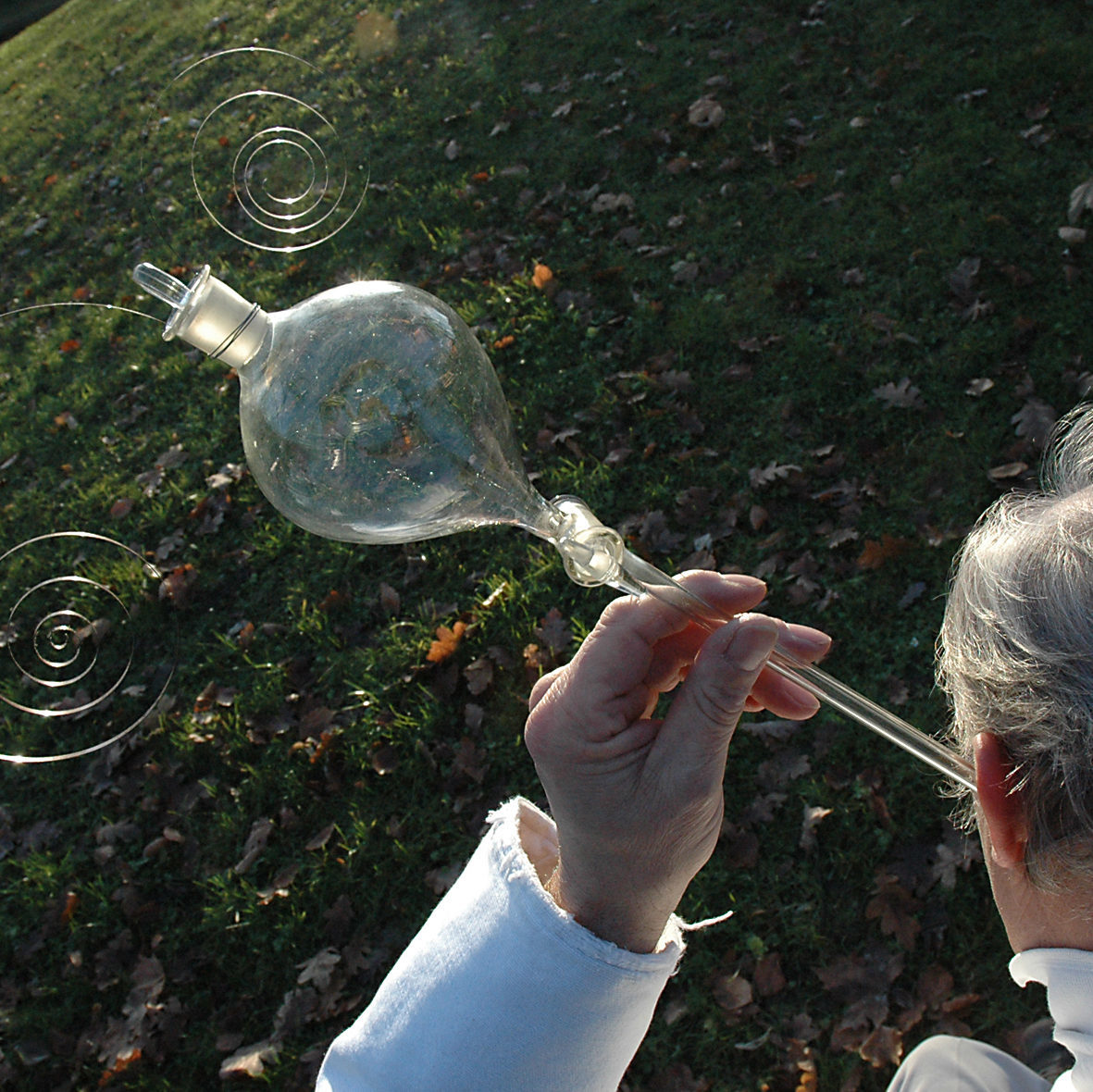
Baudouin Oosterlynck has been developing a singular artistic practice around sound, silence, and listening since the 70s. For the very first edition of Tectonics in Brussels, he brings together a selection of his remarkable listening instruments in Foyer 3.
These are not conventional sound-producing instruments, but objects that shift the way we hear. They emerge from intriguing questions: what would the world sound like with differently shaped ears? How can the hidden sonic qualities of an object be revealed in silence? And how do form, space, and air influence our perception?
Instruments such as Prothesen, Étant-donnés, Ad Libitum, and Étui-donnés invite you to listen differently — more attentively, more slowly, and with an open ear for the unexpected.
sessions at fixed times (register on-site in Foyer 3): Friday: 18:30 | 19:30 | 20:30 | 21:30 Saturday: 16:30 | 17:30 | 18:30 | 19:30 | 20:30 | 21:30
Friday 19.06 & Saturday 20.06 · Studio 3
Sound Installation: Fabio Machiavelli
-----
At the heart of Fabio Machiavelli’s work lies the idea of (re)formation. In recent years, his artistic practice has centred on new lutherie, DIY compositional practices, and the development of new instruments—much like many composers of his generation. Micro Breaths of a Blue Lung explores large marine mammals: their resonances, and their vocal and percussive dimensions. Machiavelli investigates their timbral qualities and lets them resonate through his instrumental devices. The work unfolds as a 45-minute sonic architecture built from a multitude of miniatures. During the performance, the instruments come to life through their interaction with the performers. Before and after, they can also be experienced as a sound installation, with each object inhabiting its own sonic world.
Friday 19.06 & Saturday 20.06 · Studio 2, Foyers (free)
Sonic Harvest: David Dubois, Alice Van Biesen, Livia Slegers
-----
Brussels Philharmonic commissioned young audio makers David Dubois, Alice Van Biesen and Livia Slegers to create new sound works for the Tectonics festival, inspired by the LAB-SERIES concerts.
Before, during, and after these concerts, they set out on a kind of ‘wild sonic foraging’, gathering voices, sounds, and textures—with both active and passive input from the audience. The result is three unique audio installations, presented in premiere at Tectonics.
David Dubois: All Hands All Hands invites the passer-by to pause at the threshold between the in- and outside of a concert experience. Recorded sounds originating from the supportive foundations of an event including the audience, crew and building, are edited down to their smallest transients and generatively reconnected into a new form of applause with each person’s passing through the main doors.
Alice Van Biesen: Sound does not live in a vacuum This installation exposes the dialogue between sound and space. The stairwell of Flagey was acoustically measured, its resonant frequencies uncovered and made the foundation of the composition. Eight speakers feeda composition shaped by these frequencies back into the space, amplifying what was already there. Wind speed outside Flagey drives the installation as an external and unpredictable force.
Livia Slegers: A Boat, A Memory... This installation is a collection of various short electroacoustic compositions reinterpreting and modifying sounds “harvested” in Flagey as well as other recordings. Interpreting the building as a boat, she worked around the themes of water and memories. Whether it is through the use of real water recordings or modifying the sound to evoke certain qualities of water like it’s amplitude, shape, behaviour...
With the LAB-SERIES, the Brussels Philharmonic brings together musical experimentation, interaction, and total experience. Expect bold and eclectic concert nights with unique programmes, pre- and post-concert talks, interactive installations, and immersive listening sessions.
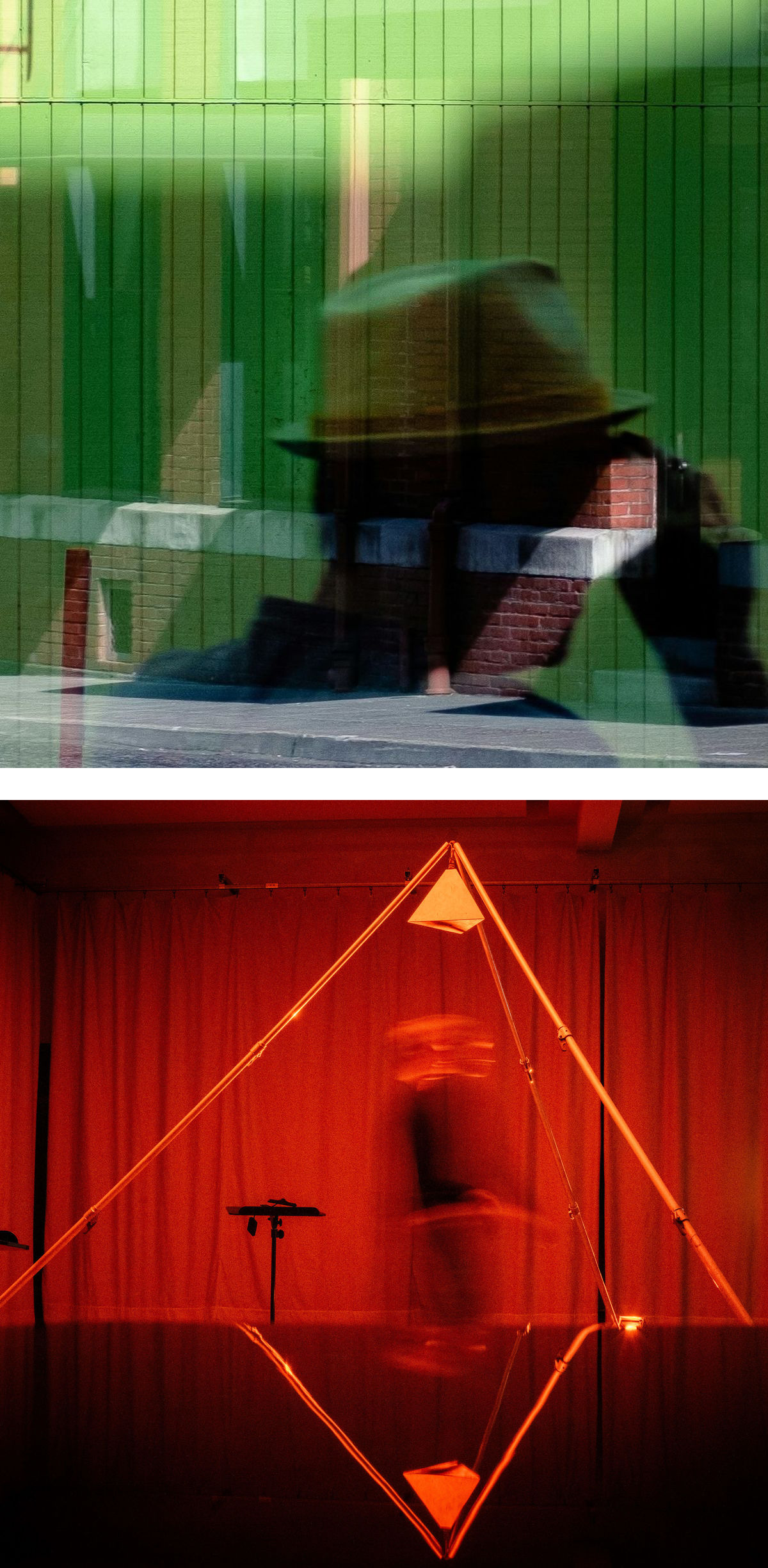
"The diverse electronic influences in both programmes I captured have been a really lucky coincidence; I’ve really enjoyed blending techniques I use for club photography with a more institutional setting.”